Friday, September 2, 2011

Kimchi Factory

The 5th WSK Camp (1)

Kimchi!
When you hear the word 'kimchi', you will relate it to Korea.

Yes, kimchi represents Korea all around the world. Korean people almost always eat kimchi in every meal.

Even if you buy pizza, toast, burger, or fried chicken which you think supposed to be eaten without kimchi, kimchi is served together with those meals.


What type of Kimchi do you know? Kimchi is not only made from cabbage, but you can also find radish kimchi, green onion kimchi or cucumber kimchi.

I came late for WSK camp in Suwon. I missed the archery practice, trolley riding, Korean dyeing class, Hwaseong tour, and Korean manners class (wearing Hanbok and tea ceremony). :(((
Not only that, I left my camera in San's bag. Oh, no! So, sorry for the low quality pictures. I captured them through my cellphone.

From Suwon station, I took taxi to the Kimchi factory, Pungmi Food.


This is picture of the owner of the factory. She was captured while arranging the seasoned kimchi into the pot for fermentation.


Again I came in the middle of the tour, so I missed to see the factory. I went straight to the small museum. It shows us many types of kimchi, the making process, and the material.


Other than kimchi, there are also many artificial tteok (Korean rice cake) in the museum to teach us about Korean culture. It was arranged such as for a special or big party (for example, 60th birthday party).


The kimchi factory has a special laboratory to do researches on kimchi and the factory's product.


And...this is the one that I like so much. The kimchi jars! After kimchi is seasoned with the spices, it is put inside the jar for fermentation.

Nowadays, people keep kimchi in a special refrigerator called kimchi refrigarator because they live in apartment and have no garden or outdoor space. The refrigerator size is quite big and usually full with ONLY kimchi. 


A close shoot of the jar. 

With Parvina.
When San first came in Korea, he hated kimchi, but he loves it now. We especially like the fresh kimchi rather than the sour kimchi (because it is kept for a long time). I can eat rice only with fresh kimchi.

Kimchi can be eaten even though it has been stored for 1 year. Some people said that the sour the better.

In winter, kimchi price can be very expensive because the increase of cabbage price. Kimchi which is supposed to be side meal, turns to be more expensive than the main menu. Buying kimchi can be too costly rather than buying fried chicken!

Wednesday, August 31, 2011

Resep Masakan Korea - 삼계탕 (Samgyetang/Ayam Ginseng)

I found 2010 Calendar and wanted to throw it out because I didn't need it anymore but my eyes caught the Korean Food recipe written in Indonesian. I thought that it would be great to write it down here not only for me to learn how to make it someday but also could be useful for everyone craving for the savoury of Korean Food.

The recipe will be written in Indonesia, though. Anyway, you can always use Google Translate button provided in my blog page to translate it to your language.

Musim panas, orang-orang Korea suka sekali makan Samgyetang, terutama di tiga hari terpanas (Sambok) selama musim panas (dibagi menjadi 3: chobok, jungbok, dan malbok). Samgyetang ini kaya akan nutrisi dan sangat berguna untuk kesehatan dan kebugaran tubuh. Rasanya....yummy yummy yummy!


Samgyetang ini bahan utamanya adalah ayam. Hampir mirip dengan ayam tim (ayam kuah), tapi bumbunya yang berbeda plus ada nasi ketan yang dimasukkan ke dalam ayam. Rasa ginsengnya juga terasa sekali. Bahkan minuman pendampingnya pun wine dari ginseng.

San sejak kecil paling tidak suka makanan dari ayam, terutama ayam yang tidak digoreng. Sebut deh...ayam kukus, ayam kuah, ayam tim dll...Ayam goreng sih masih bisa makan, tapi bukan favorit.

Ban Samgyetang di kantin kampus, harganya terjangkau, cuma 3000won,
tapi cuma separuh porsi dari ukuran normal, dan rasanya kurang kaya (tanpa ginseng).

Sebelum makan samgyetang, aku sudah jelaskan ke dia, ini makanan yang bagaimana. Dari awal sudah ilfil duluan deh...Tapi karena waktu itu aku kepingin banget, terpaksa deh dia ngikut hehehe...Porsinya cukup besar lho. Karena ini satu porsi ayam utuh untuk satu orang. Jadi harganya juga agak mahal dari makanan biasanya. 1 porsi samgyetang bisa berkisar antara 9000-15000 won.

Dan ternyata saudara-saudara...ini yang San bilang "Mau aku makan samgyetang lagi. Makanan ini sehat banget rasanya...enak..."

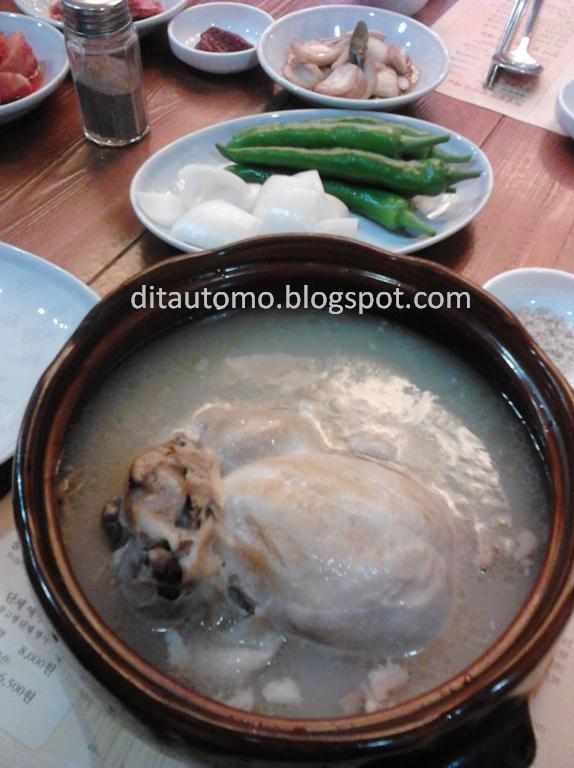
Samgyetang, waktu dinner the 5th WSK Camp di Suweon.
Makan tanpa nasi, karena porsinya cukup besar. Harga 15000 won.

Hohoho...ayuk...kapan makan samgyetang lagi...mau summer atau winter, makan samgyetang tetap menyenangkan....^^

삼계탕 (Samgyetang/Ayam Rebus)
Bahan:
1 ekor ayam
0.5 gelas beras
Bahan-bahan campuran:
4 siung kurma
3 siung bawang putih
1 buah ginseng
3 siung bam/walnut
garam
merica

Cara membuatnya:
  1. 1 ekor ayam belah bagian dada dan buanglah seluruh isinya kemudian cuci bersih sampai tidak ada darah yang tersisa kemudian tiriskan.
  2. Lalu siapkan beras.
  3. Cucilah ginseng, lalu kupas bersih bam/walnut, begitu juga cuci dengan bersih kurma.
  4. Ayam yang telah dibelah, masukkan di dalamnya beras, ginseng, bam, bawang putih, kurma, kemudian tutuplah dengan tusukan kayu agar tidak terbuka.
  5. Letakkan ayam yang telah diisi, di dalam panci masak, lalu rebus hingga mendidih, setelah mendidih kurangi besarnya api dan terus rebus hingga lama sampai air kuah menjadi berwarna putih.
  6. Setelah matang bukalah tusukan atau benang yang digunakan sebagai penutup dan letakkan dalam mangkok kemudian beri sedikit garam dan merica, lalu hidangkan.

Monday, August 29, 2011

Summer Trip (4) - Oedo Botania


NIIED KGSP 2010, Silla University - Summer Trip (4)

Last destination of my summer trip was Oedo Botania. Yuhuuuuuuuuuu! From the picture above, you will agree with me if I say that it is wonderful!

See previous post if you haven't read it.

I would say that Oedo Botania is a perfect blend of nature, ocean, sky, plants...It is just perfect!

Oedo Botania is a marine botanical garden which is 4kms from Geoje-do. So after touring around Haegeumgang (read the previous post), the boat moored in Oedo island. The entrance fee is 8,000 won.


The type of its landscape is toward European garden. I would say that spring is the best time to visit Oedo island, because you will be able to see the island covered by flowers. Summer is not the best because of the weather is super hot!


On 1969, Lee Chang Ho came to this island to escape from the wind and waves when he was fishing. He found that the island was so beautiful and wanted to live there. So, he and his wife bought the island and dedicated their life to create the wonderful landscape for more than 30 years. 

The house is the place where the couple live. However, the husband has passed away few years ago. The wife built a memorial statue in the garden for the remembrance of her husband.


Since the garden is famous with its beauty, it was used as a scene location for a KBS drama "겨울 연가" (Winter Sonata). It is a very popular drama, not only in Korea or my country but I think all around the world.


When you are at the garden, you can feel the gardeners' passion in creating, cultivate or designing the garden. You can see many types of plants, you will be surprise! Also, I think the gardeners really worked in details, from the pathway, bench, fence, sculpture, etc...you named it.

In an area where the small chapel is, there are some small boards on the garden telling us the gardeners' heart. One of them is "Gardening is my life".

PS: This is the end of Summer Trip posting series ^^ Thank you for reading.


Read also:

Sunday, August 28, 2011

생일 축하 해요

Have a blessed birthday Hon Ayank.

I just want to say that "I love you so much".
I want to always love you by God's gracious love.
Because of His love, we can live in His miraculous world.

I Corinthians 13:4-8, 13

Love is patient, love is kind. It does not envy, it does not boast, it is not proud. It does not dishonor others, it is not self-seeking, it is not easily angered, it keeps no record of wrongs. Love does not delight in evil but rejoices with the truth. It always protects, always trusts, always hopes, always perseveres. Love never fails. But where there are prophecies, they will cease; where there are tongues, they will be stilled; where there is knowledge, it will pass away.

And now these three remain: faith, hope and love. But the greatest of these is love.

God bless you hon.

-san-

Saturday, August 27, 2011

Cambridge Series - The City

Hello again...

Today I want to share some pictures of Cambridge.
It was a beautiful city. When I was there (July 17-27, 2011), I imagined that I had been living in a dream. Because if you see the sceneries, those look like paintings in a gallery.
You can enlarge every picture below by clicking on each of it.


Pictures above shows some buildings and houses around the city. Most of those buildings is very old. I am impressed to how they maintain their properties.


There were some buildings which built in the corner of streets. You also can see how colorful they painted their houses related to their neighbours'.


It shows some signposts of a park/garden, and a park called 'Jesus Green'. Was that beautiful?
You can also see a typical map around in Cambridge city. It shows some public facilities, some important buildings, and the way you get there.


First two pictures shows the signpost of parking lot spaces and pedestrians signals. The first shows how many parking lots were still available, and the second directs pedestrians when they can get across the street.

The latter twos were showing old and new model of parking lots' meters. People who want to park their vehicles on a particular road should put some money on it. It costs 20 pence (350 won/2,800 rupiahs) for each 15 minutes, and can only park for maximum of two hours.


This picture shows some public facilities.
Can you see interested design of a bus stop? Perhaps the designer thought that it will be more convenience for passengers to wait behind the glass. It will probably protect them from splashing water from vehicles, dusts, and other debris. Great idea!

Cambridge maintains her public phone box as well. Most of them had been working good. It costs 60 pence (1,050 won/8,400 rupiahs) for one hour to any landline (non-mobile) phones around the country, but can call mobiles for about three minutes for the same amount.

Bottom left picture shows two trash cans. One was for recyclable things, and another was for non-recyclables.

Bottom right was a picture of a letter box in Cambridge. One of my friend told me that it looked like a letter box in Mr. Bean's show. Yes, it was!
The last collection time was written on it: Mon-Fri 6.15 pm, and Sat 12.45 pm.


You can see here another signpost which shows the directions and some pictures of roads and streets. We should assume that a road tend to be bigger or wider than a street.

Because Cambridge was not a very big city, it was hard to find high rise buildings there, instead you can still find a lot of narrow streets or pathways (In bahasa, we called it a 'gang')


Two pictures above show Sir Isaac Newton's public house where became a pub since at least 1886 and a picture of an apple.

Sir Isaac Newton entered Cambridge University in 1661 and became a fellow of Trinity College in 1667.

Can you see the apple there which was not bitten yet? It just compares to an apple inc.'s logo which was bitten already.


It shows some transportation modes in Cambridge. You can still see a lot of people was cycling around the city of Cambridge. Don't be surprised if they will put their bicycles on any possible places or stands including the church' s fences (bottom right).

Cambridge has "park&ride" city busses, busses, busway, transport for schools, and "Hop-on Hop-off" tour busses (especially for tourists).

Hop-on Hop-off tour busses will go around the city for approximately 80 minutes with price guide as follows:
* Adult 13 pounds (23,000 won/182,000 rupiahs)
* Child (5-15 years) 7 pounds (12,300 won/98,000 rupiahs)
* Senior/Student 9 pounds (15,900 won/126,000 rupiahs)
* Family (2+3) 32 pounds (56,500 won/448,000 rupiahs)


I found a new dan interested thing in Cambridge which never saw it before. It was called a rising bollard. It was automatically down when there was a known vehicle want to go by, and it was automatically up when the vehicle pass through it. Why I said a known vehicle, because I was waiting long time enough to see another vehicle which cannot pass through it, because the bollard was not going down even the vehicle passed the camera line and very near to the bollard :)


It shows pictures of people from around the world who came to Cambridge for various activities which most of those are for vacation.

Up left shows a musical group performed their songs and people might donate some pence or buy their cds. I believe that they sang latin/spanish songs.

Bottom right shows a Sainsbury's supermarket auto-cashier. I tried twice, but feel awkward, because I was not used to it and didn't know how to do it.

By the way, I think we still need another people to do it for us, even nowadays all items/goods was barcoded already and we can check out by ourselves. I am afraid that in long term practices, people may not have any kind of relationships with other people in any kind of business, and people may lost their occupations because machines replace their positions. In short, I think that we as human being still need to relate to other people not just a machine. What do you think?


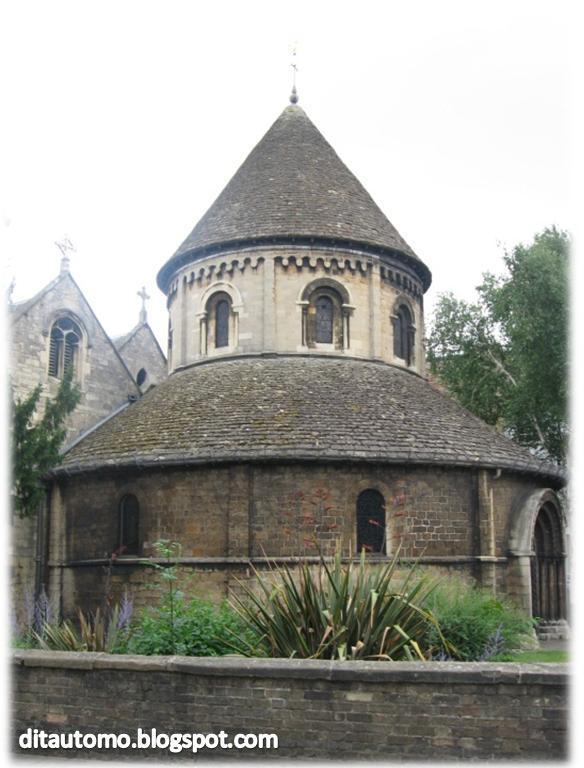
This is called Round Church. Nowadays, it is no longer a working church, but a museum of Christian heritage. It was built in 1130 AD by the fraternity of the Holy Sepulchre. It is one of only 4 round churches in England. They were all built after the first Crusade and the shape is probably influenced by that of the Church of the Holy Sepulchre in Jerusalem.


This building was called Britannia Building Society. This building society serves as a bank and related financial services, especially mortgage lending. Nowadays, the building society must compete with banks for most consumer banking services. These institutions are found in the UK and several other countries.

What do you think about the city of Cambridge?
Please wait for my report about "The River" next week. See you.
Thank you for reading.

-san-