Showing posts with label Korean Culture. Show all posts

Sunday, May 20, 2012

Let's JUMP!


I had been waiting for a chance to see JUMP performance since 2009! I saw the advertisement on the way to subway station in Busan and since then were curious to see the martial arts performance.

This week I received an offer to see the performance, free ticket from KTO (Korean Tourism Organization), specially given to the members of K-Performance Supporters. JUMP: Comic Martial Arts Performance was held in Busan Citizens Hall on May 19-20, 2012. I chose to see Saturday performance, from 3 to 4.30pm.


JUMP is a combination of various martial arts (Tae kwon do and Tae kyun - which are Korean traditional martial arts), drama and comedy. JUMP mixs the actors' talent in martial arts and acrobatics with the perfect acting. The actors successfully 'wow' the audiences and also make them laugh. This was the reason why I really  want to see JUMP. I was interested to know how the traditional martial arts mixed with interesting scenario and drama can be performed and introduce to audiences. This is obviously a brilliant method to keep the traditional arts alive.


I went there alone since I only request 1 ticket. I came too early, soo when I arrived in Busan Citizens Hall, I saw many people were waiting in front of the building. Some of them exchanging their invitation to tickets, some are waiting in line to purchase tickets. I saw many children -elementary school age- were taking pictures in front of JUMP big poster. Interestingly, when their teacher took the picture, they jumped! Just like the tittle of the performance. :)


I like the performance, especially when seeing them performed their ability in martial arts and acrobatics. Most of all, I love the last scene when all of them together or one-by-one run and jumped with various style across the stage. It was awesome!

Friday, May 4, 2012

Children's Day in Korea and Indonesia

May 5th, is Children's Day in Korea. It is a national holiday so if it is on weekday, parents don't go to work so they can bring their children to go out and spend time with them. In Korea, many cities will celebrate the event on Children's Day in festivals or performances. Besides that, zoo, museums, amusement parks offers special discounts or free admission for children.

Children's Day Celebration at Seoul Children's Library
Children in all ages in Korea are waiting for this event because the will receive presents or money from their parents on that day. If you go to supermarket, bookshops or toys stores, you will see many toys, clothes or children's book are displayed for parents and children, for them to easily choose the gifts for the children.

Historically, the Children's Day was founded in 1923 by Bang Jung-hwan, a Korean children's writer and storyteller. Originally it was celebrated on May 1st, but then was re-established on May 5, 1946 after the occupation of Japanese. The Children's Day aimed to highlight the importance of children for the nation, their need of love and care, and in the same time also to honor parents and those who contribute in raising and improving the children's lives. Bang Jung-hwan wrote " Children are the heroes of tomorrow. May they grow to be gentle, vigorous, and wise."

Bang Jung-hwan

In Indonesia, Children's Day is celebrated every July 23rd. It is not a national holiday but usually it is marked  in the calendar to note that it is a special day. Also, there is no celebration such as parents give present to their children like in Korea, but children has many activities such as traditional games, drawing competition  or ceremony at school like what I used to have in my childhood.

Balap Karung, a traditional game played on Children's Day in Indonesia

Drawing competition held on Children's Day in Medan, North Sumatera, Indonesia
Back in my childhood, the ceremony on Children's Day in my hometown was held not at school but in the city's square participated by all of kindergarten and elementary school students. We wore school uniforms and cone hat decorated with colorful papers which was made specially for the day. My mom and her staffs would be busy prior to the celebration of the day because she received many orders of the cone hats for the ceremony. I were busy helping her, too. What a unforgettable memory! How about Children's Day celebration in your country?

My mother, brother and I were getting ready to go to Children's Day ceremony.
Happy Children's Day to all children in Korea! ^^

Picture sources:
Children's Day Celebration 
Bang Jung-hwan 
Balap Karung 
Drawing Competition 


References:
http://news.naver.com/main/read.nhn?mode=LSD&mid=sec&sid1=102&oid=003&aid=0004481323
http://www.arirang.co.kr/News/News_View.asp?nseq=115641&code=Ne2&category=2

Tuesday, April 10, 2012

[Korea] Korean Cookbook - Translated in 10 Languages

When I saw Korea Tourism Organization's Facebook page, I jumped happily!
They posted about a new released book of Korean Family Foods, and it is translated in 10 languages: English, French, German, Chinese, Japanese, Vietnamese, Mongolian, Thai, Filipino, and Indonesian. Oh, yes! Learning to cook Korean food will be so much more easier for foreigners.


The English version

The Indonesian version


The book was published by The Community Service Group of Daewoo Securities Co., Ltd. to introduce many kinds of food usually found in the table of Korean family. I believe this book will help many people around the world to learn and make their homemade Korean food. 


Kimchi recipe


The book consists of many types of Korean food ranging from kimchi, side-dishes (banchan), steamed vegetables (namul), soup (jigae), special food (such as bulgogi, samgyetang, galbi jjim) and snack (gansik). 
Beside that, this book also provide the readers with Korean culture of cooking, tips on how to make delicious soup stock, choosing right cooking utensils and tips on buying the ingredients.


I checked the book in Kyobo Bookstore website and found that the price is not too expensive, 12,000 won. And...I have sent to my husband the link of the book in Kyobo website, asking him to buy it for me ^^ Can't wait to serve Korean family food for my little family!


Source:
http://english.visitkorea.or.kr/enu/FU/FU_EN_15.jsp?cid=1594947
http://www.kyobobook.co.kr/product/detailViewKor.laf?ejkGb=KOR&mallGb=KOR&barcode=9788960512108&orderClick=LAH&Kc=

Thursday, April 5, 2012

[Korea] Busan Biennale 2012


Among many festivals that will be held in South Korea, Busan Biennale 2012 is on top of my list to visit. Busan Biennale is an art festival that integrated three different festivals: Busan Youth Biennale, Busan Sea Festival and Busan Outdoor Sculpture Symposium.

 Artwork from Busan Biennale 2010: SataRLIT, by SATA

Changing the name into Busan Biennale in 2002, Busan Biennale is recognized as a major international culture and art festival of the city of Busan. It became one of the largest art festivals in Korea. Many artists came to Busan to install and exhibit their creations and artworks. The exhibitions took place not only in Busan Museum of Modern Art or Busan Cultural Center, but the installed contemporary art works could be seen in outdoor places such as Gwanganlli Beach and Busan Yachting Center.  

Artwork from Busan Biennale 2010: Structure & Force, Language Series, by Shin Sang Ho

Artwork from Busan Biennale 2010: Untitled, by Chritina DY. 
It was made of charcoal. Video of the making could be seen here

The biennale art event is an event that presents the hard-to-understand contemporary art to the public and gives easy interpretation about it. It is served for public to have an access to contemporary art and to communicate with professional artists both from Korea or other countries. 

Artwork from Busan Biennale 2010: Stage of Meditation, by Anxiong Qiu. 
Location: Gwangalli Beach.


Artwork from Busan Biennale 2010: We Must Be Seen, by Jung Seung. 
Location: Gwangalli Beach.

This year Busan Biennale 2012 will be held in various venues in Busan from September 22 to November 24, 2012.  It was reported that about 270 works by 110 artists from all around the world will be displayed in the biennale under the title "Garden of Learning". 

Roger M. Buergel

The title "Garden of Learning" is an idea from the artistic director of Busan Biennale 2012, Roger M. Buergel who was also the artistic director for Documenta XII Kassel. He proposed the idea of stage collaborations between artists and audiences as the key element of this year biennale. The goal is to create long and lasting effect of the exhibition to the community. People are not supposed to just see the result of artistic creativity or the objects of the exhibition but take part into the process of artistic production. To achieve the lasting effect, the communications between artists and audiences shall start prior to the official exhibition.

Image: Labyrith Garden Château de Vendeuvre (1750), Normandie, France 

As a result, the Busan Biennale offers to local people, both Korean and foreigners who have interest and idea to participate in the planning stages of the Biennale. The "Learning Council" initially looked for 10-12 members who will have the role as intermediary between participating artists and visitors. The Learning Council will also be the source for  participating artists about the history of Busan, the characteristic of people in Busan and any information that  they need for research. However, apparently, more than 100 people showed up their interest and attended the first meeting of Learning Council in February, 2012.

It was presented by the artistic director on the international symposium last year in Busan to make the biennale as unique and different from any other previous biennales around the world that tend to be similar to each other. Personally, I agree with the idea that it is important to make a biennale with characteristic of the place where it is held which by then Busan Biennale has its differentiation from other biennales in the world.

Source:
http://www.busanbiennale.org
http://gardenoflearning.info/blog/
http://www.e-flux.com/announcements/roger-m-buergel-appointed-the-artistic-director/
http://koreajoongangdaily.joinsmsn.com/news/article/Article.aspx?aid=2949948

Friday, February 3, 2012

[Korea] Haewoojae, Mr Toilet House


Haewoojae (or Mr Toilet House) is the name of the house of the late Mr Sim Jae-duck, located in Suwon. Haewoojae has the meaning of a house to relieve worries and the name came from Haewooso, the toilet referred to in temples.


I visited this place with the group of World Students Korea 5th Batch last year. It was written only 'Haewoojae' in the schedule without any explanation about it, so I didn't aware that we were going to go to a house that has a toilet shape as its architecture!


 Mr. Sim jae-duck renovated his own house and named it as 'Haewoojae' in commemoration of the establishment of the World Toilet Association. After the passing of Sim Jae-duck, the family members donated Mr Toilet House to Suwon City.

He was born with a passion to develop the toilet culture movement, that is why he was given the name 'Mr. Toilet'. The house is recorded by Korea Record Institue as 'the largest toilet structure work' as the first of its kind in Korea in 2007.

Toilet culture movement itself, started when he himself as the Mayor of Suwon City was preparing for the 2002 FIFA World Cup games in Suwon. He declared that all public toilets in Suwon to be made as the most beautiful toilet in the world.


Conventional toilet and the beautiful toilet projects in Suwon

First Floor

On the first floor, you can see many pictures about the conventional toilet and improvement project around the world (including my country, Indonesia), interesting toilet story where you can see many toilet signs around the world and stories about toilet, and also toilet culture movement in Suwon.

The shape of the house is just like the shape of a toilet with the toilet in the middle of the house which bring out the central part of living (see the pink color in the middle of the 1st floor plan, it is the toilet!). 


Mr Sim Jae-duck thought that toilet should not be always at the back or hidden somewhere, dirty or should not be exposed. He has another point of view. The toilet became the space for him to appreciate the outdoor garden or spend time to think things over the frontal glass at normal times (see the picture above - Transparent Glass) . But when the toilet is 'in used' - the light is on for physical needs - the glass is turned into unclear glass design. Interesting!

Looking around the first floor.

Second Floor

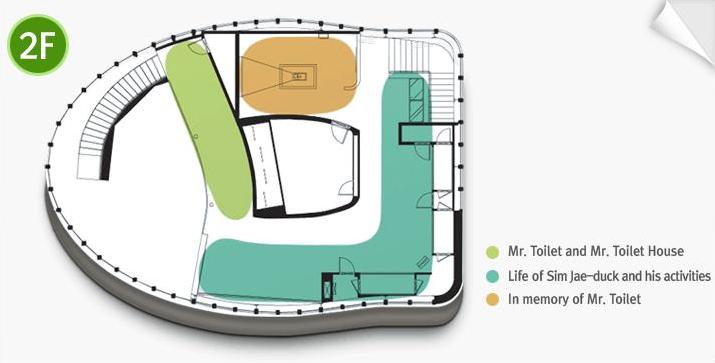
Second floor is dedicated for the passionate life of Sim Jae-duck. Also, you can go to the roof top, to take picture and look around the site. There will be the first 'toilet culture park' next to the Mr Toilet House, that will be built soon.


On the roof top, you can clearly see the toiilet shape.

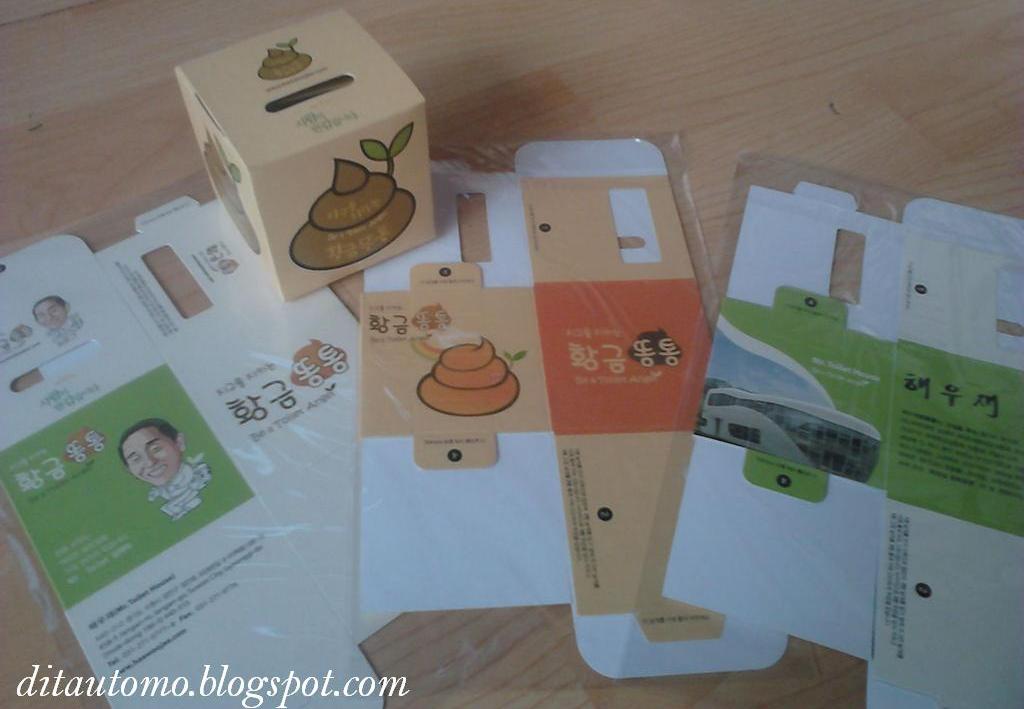
I received many good and cute things on the visit to Mr Toilet House:

This is an explanation about the toilet culture movement, and you can stamp any stamps you like on the empty space.

Mouse pad, post-it and 24K gold plate.

Moneyboxes

Moneybox in 'unusual' shape :) It is to remind us to become a 'Toilet Angel'.

References:
Haewoojae website
WSK 5th batch visit to Haewoojae 

Tuesday, January 31, 2012

Korean Children Song (동요)

I love to teach children song to my baby. I usually sing for him nursery song in English or Indonesian which I know very well. But since I sent JoSH to daycare (orini jib ~ 어린이 집), I tought that he must have learnt some Korean Children song in the daycare. 


Previously I just knew 'The Three Bears' song which is very popular since it was also sung in Korean drama 'Full House'. It is the first children song I learnt in Korea. Knowing only this song and sings it every time to the baby made me curious to know and learn other Korean children songs.


I came across this video in youtube and listened to the songs. Three of the songs are popular song in Korea. The rhythm and melodies are so easy to follow. It didn't take me a long time to memorized the easy-to-sing songs and the simple movements. The lyrics also has simple meaning but suitable for children. We feel happy whenever we sing these children songs.


Here is the lyrics and the translation if you want to sing together with your kids:


옹달샘 ~ Mata Air/Sumur Kecil

깊은 산속 옹달샘, 누가 와서 먹나요?
Small deep spring in the forest, who will come and drink?
맑고 맑은 옹달샘, 누가 와서 먹나요?
Small clear spring in the forest, who will come and drink?
새벽에 토끼가 눈 비비고 일어나
In the dawn, rabbit rubbed its eyes and woke up
세수하러 왔다가 물만 먹고 가지요.
She came to wash her eyes, drank the water and went away.
  
깊은 산 속 옹달샘, 누가 와서 먹나요?
Small deep spring in the forest, who will come and drink?
맑고 맑은 옹달샘, 누가 와서 먹나요?
Small clear spring in the forest, who will come and drink?
달밤에 노루가 숨바꼭질 하다가
In moonlight, when deer play hide and seek
목마르면 달려와 얼른 먹고 가지요.
If she feels thirsthy, run and drink quickly, and then go away.


퐁당퐁당 ~ Plop plop


퐁당퐁당 돌을 던지자, 누나 몰래 돌을 던지자 
Plop plop throw the stone, when sister doesn't know, throw the stone
냇물에 퍼져라 멀리 멀리 퍼져라 

The ripples are spread away, spread far-far away
건너편에 앉아서 나물을 씻는 

Sister is sitting on the other side, washing sprout
우리 누나 손등을 간지러 주어라. 
Let's tickle our sister's hand with the gentle waves.

퐁당퐁당 돌을 던지자 , 누나 몰래 돌을 던지자 

Plop plop throw the stone, when sister doesn't know, throw the stone 
냇물아 퍼져라 퍼질대로 퍼져라 

The ripples are spread away, ruffle to the other side 
고운노래 한마디 들려달라고 

Making you plop, plopping sounds into a beautiful song
우리 누나 손등을 간지러 주어라. 

Let's tickle our sister's hand with the gentle waves.


둥글게 둥글게 ~ Round Round

둥글게 둥글게  둥글게 둥글게
Round, round, round, round
빙글 빙글 돌아가며 춤을 춥시다
Follow the music, move around and let's dance
손뼉을 치면서 노래를 부르며
While clapping hands, sing the song
라라라라 즐거웁게 춤추자
Lalalala, let's dance happily

링가링가링~가 링가링가 링
Ring ga ring ga ring ~ ga ring ga ring ga ring
링가링가링~가 링가링가 링
Ring ga ring ga ring ~ ga ring ga ring ga ring

손에 손을 잡고 모두 다 함께
Come together, hand in hand
즐거웁게 뛰어봅시다
Let's jump happily

둥글게 둥글게 둥글게 둥글게
Round, round, round, round
빌글 빙글 돌아가며 춤을 춥시다
Follow the music, move around and let's dance
손뼉을 치면서 노래를 부르며
While clapping hands, sing the song
라라라라 즐거웁게 춤추자 .
Lalalala, let's dance happily

Credits:
비/ Bi (Rain) Singing 3 bears ~ (Full House): uploaded by Arygato1
[HD] 20100711 SS501 with children: uploaded by suangs
퐁당퐁당 picture: http://cafe.daum.net/snulaw17

Tuesday, January 24, 2012

New Year in Korea - Seollal (설날)

Korean New Year is typically known as Seollal (설날). It is the first day in lunar calendar. Of course, people also celebrate solar new year in January 1 each year, but Seollal is more important than solar new year. Usually, there is three days holiday for Seollal (there is only one day holiday for solar new year), one day before, the new year day, and the day after. 


The video below will give you general idea about Seollal and the traditions.


In Seollal, people will go home to meet their family and relatives, especially visiting the older people (parents and or grandparents). They will take many hours to go to visit their loved one despite the heavy traffic. Also, Koreans will wear their traditional clothes on new year day, which is hanbok. However, some families choose not to wear hanbok anymore, because they become less formal and due to the expensive price of hanbok, kids who grew up don't have any hanbok perfect for their size anymore. Women are busy at home cleaning houses and cooking. They prepare so many food to eat on Seollal, no wonder the activities in market few weeks before Seollal is always so high and crowded. 


Other than tteokguk (떡국) - soup with sliced rice cakes, which is a custom food in New Year, ritual ceremony and folk games played in New Year, the important one to do is 'Sebae', which is a deep traditional bow.  Children or younger person shall bow to older ones and say '새해 복 많이 받으세요' which can be translated as 'Receive many blessings in New Year'. Then, older people will give pocket money for children.


The video below showing the tradition and method of giving Sebae to older people:


Also, this video is so cute, showing children with their colorful hanbok doing sebae and receive their pocket money from their grandparents.


I remembered that my Korean Language teacher has taught me to do Sebae and followed with the tea ceremony. We were in Korean Culture Class at that time, so we wore hanbok and practiced the culture together.Here are the pictures. 


You can notice that men and women have different method of Sebae. Men bow so deep until their head touch the floor, but women do not do the same. Besides that, hand position and sitting position after doing Sebae are also different.  The class was so interesting for me. Even though in Indonesia, there is celebration for lunar new year which we called Imlek or Chinese New Year, but the traditions are not the same. 


Happy New Year to all of you.


With love from Busan,
Dita ^^

Friday, December 23, 2011

[Korea] Bibap Musical - A Must See Performance


Bibap musical performance is in Busan since today till January 1, 2012. I really really want to see!
Bibap is a performance made to introduce Korean food, Bibimbab to the world. If you wanna know what Bibimbab is, please see my previous post here

Through the comedy musical, Bibimbab as the representative of Korean food is introduced to many people. By seeing the performance, people can enjoy the music, and also learn something about Korean culture. 

This is the detail of the performance if you want to see:

Date: 2011.12.23 - 2012.01.01
Time: Mon-Fri, 8pm; Sat, 4pm & 8pm; Sun, 2pm & 5pm
Place: Concert Hall, Kyungsung University, Busan
Duration: 80 minutes
Children more than 36months are allowed to see performance.
Price: R seat, 50,000won; S seat, 40,000won

You also can buy tickets here:


There are 8 chefs that will perform on the Bibap musical. Each of them has their own characteristic. 


The synopsis starts from Sushi, Pizza, Chinese chicken noodle, and the last order for the chefs is Bibimbab. More detail synopsis can be read in the pictures below (taken from www.bibap.co.kr):


  So...are you hungry now??? Hurry up, buy the tickets. Enjoy the show! Enjoy the meal!